Testimonies
Practice of kidnappings and unlawful arrests
The Natalia Estemirova Documentation Center Database (hereinafter the Database) collected a large number of documents detailing unlawful arrests and kidnappings during the armed conflict in the Chechen Republic. At least 6,185 people[1] became victims of such violations committed in the following manner:[2]
| Category | Number of victims |
| Kidnapped | 2,599 |
| Kidnapped as a result of sweeping operations (zachistkas, addressed operations, etc.) | 2,365 |
| Arrested by law-enforcement officers | 954 |
| Arrested after zachistkas454 | 454 |
| Attempted kidnapping | 18 |
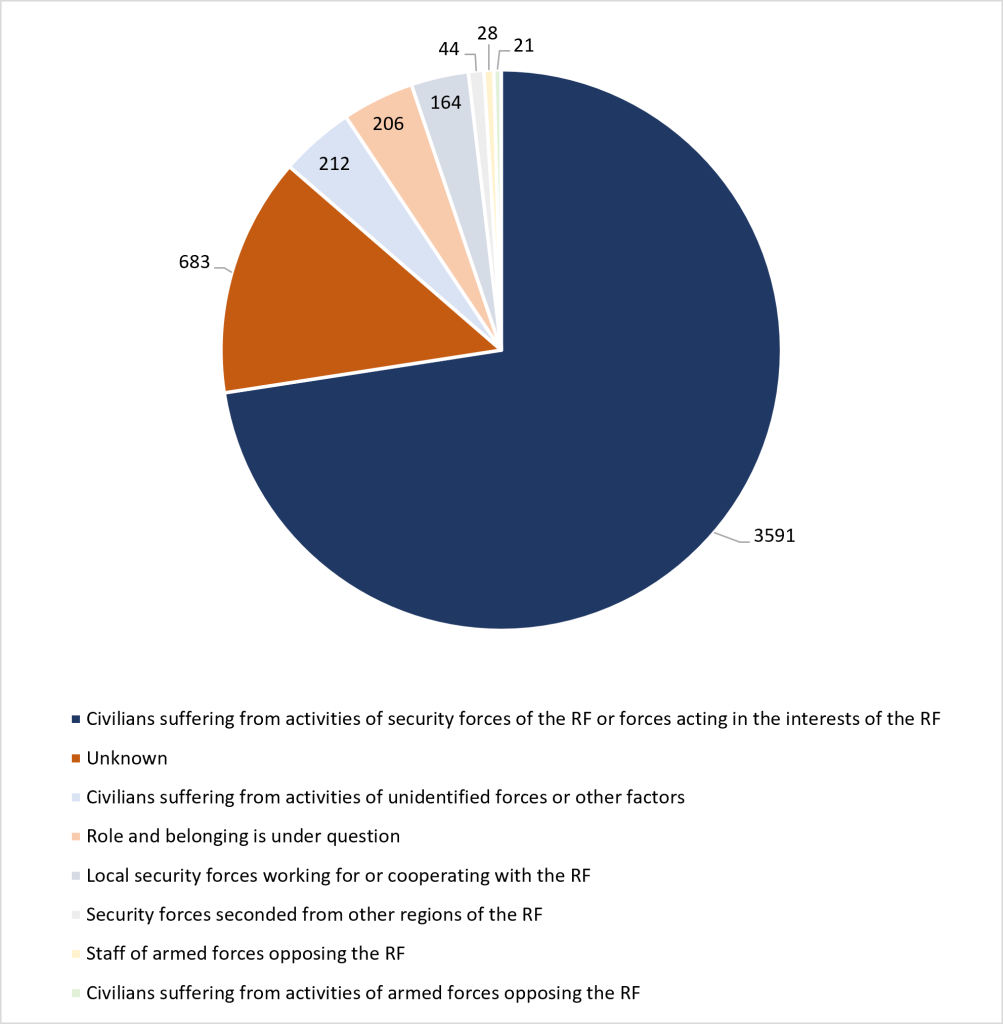
As is evident from the table, the largest number of victims were subjected to indiscriminate kidnappings. Of the 2,599, more than half – 1,527 victims – belonged to the civilian population and suffered as a result of actions committed by the military or law enforcement officers (chart 1). It should be noted that such kidnappings did not occur within the framework of special operations, but on a random and arbitrary basis.
For example, in one case, a 61-year-old man was caught by soldiers from the 245th regiment and taken to the regiment premises. His donkey-cart and 136 rubles were taken from him by the military and he was beaten and subsequently thrown into a hole. A few days later, at the request of influential individuals from his village, he was released, however the military did not return him his donkey-cart.[3]
In addition to civilians, local law enforcement and security officers were also arbitrarily kidnapped, with 164 such victims registered in the Database. Among them are three private security officers, who were detained when returning home from their shift by employees from an unknown security agency. The detainees were kept at an unknown location for the night where they were beaten and tortured in an effort to obtain testimonies from them in relation to irregular fighters. The following day, they were found by relatives on a street near the commandant’s office of the Zavodskoy District. Due to concerns for their safety, the victims refused to disclose any details relating to their abduction.[4]
Another 44 victims of arbitrary kidnappings were members of the military personnel or security forces seconded to Chechnya. In most cases, members of illegal armed groups or unidentified perpetrators were responsible for the violations. For example, in March 1999 while traveling by train in the direction of Moscow-Tbilisi through the territory of the Chechen Republic, unidentified persons detained and kidnapped an employee of the Pacific Fleet near Chervlennaya station. The victim was held in detention in an unspecified location and was later taken to the border of the Republic of Dagestan at the checkpoint of the Khasavyurt District, where he was released.[5]
At least 3,310 people were detained during large-scale and targeted zachistkas carried out by the military or other members of the Russian security forces. In the first case, the detentions were most often of a mass nature with special detention facilities for large numbers of people, while in the second case they were limited to the capture of one, two or a few people. Even in the course of the operation, the law enforcers could act arbitrarily, making detentions without any justification. The only thing that distinguishes them from detentions in other circumstances is that they are planned and organised. Large-scale and targeted operations, or zachistkas, were not random, they were carried out according to pre-determined plans, and for many years they have been the basis for the actions of the Russian security forces in the territory of the Chechen Republic itself and its neighbouring regions.
It has been established that during the zachistkas at least 419 individuals suffered while they were suspected of committing a crime. The detainees were generally suspected of collaborating with illegal armed groups.
In addition to the above, law enforcement officers also detained a further 1223 individuals suspected of terrorist crimes. Such arrests were conducted outside of the context of the zachistkas.
Detentions, regardless of the context in which they occurred, were usually accompanied by the commission of other violations against the detainees. According to the Database, victims were often subjected to beatings and even torture whilst in detention. As a result, those that were only beaten were considered relatively fortunate in comparison to the others who either never returned or were killed. Detentions also occurred with violations of the right to property, as perpetrators either looted or destroyed victims’ property. In some cases, a ransom was demanded from the victim’s relatives in exchange for their return.
Thus, out of 6,188 victims, at least 1,482 never returned home, of which 611 disappeared after being kidnapped. It should be noted that the fate of 780 victims was initially known for a period following their arrest, as information was available concerning the location of the detention. However, once relatives lost contact with the detainees the victims disappeared without a trace. In total, at least 244 victims disappeared in various filtration camps or filtration points. At least 110 victims disappeared after they were taken to a military base in the village of Khankala. It is known that among the 572 that disappeared, 20 were women, 18 were minors and 11 persons were over the age of 60.
Certain number of victims were killed in detention and their bodies were only discovered some time after their kidnapping. Often, relatives had information about the location in which the victims were detained prior to being murdered. The bodies of at least 34 victims were found in the area of Khankala.
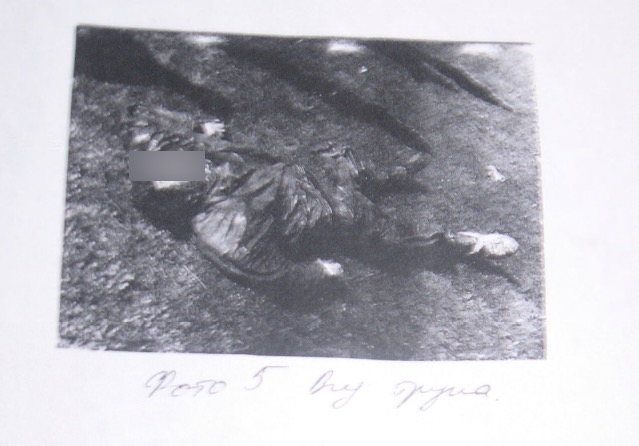
On 11 March 2001, a zachistka was conducted in the city of Argun which lasted more than three days and resulted in the detention of several individuals by servicemen. During this time, the city was completely blockaded and people were prevented from entering or leaving. On 13 March, while patrolling around the Russian military base in Khankala, soldiers discovered a recently dug irrigation ditch which they initially believed to be the location of a landmine. However, once deminers arrived to the location, instead of finding a landmine, they discovered the human remains of four bodies bearing gunshot wounds to the back of the head and also in the back. The bodies were found without clothes and traces of an autopsy were present – incisions were found from the neck to the groin area. The bodies were of some of those arrested earlier in Argun.[6]
The materials registered in the Database show that at least 2,280 individuals were tortured or ill-treated during their arrest or detention.
In one of the cases, in the place of detention, in a pit on the outskirts of the village, a kidnapped man from the village of Starye Atagy was beaten and tortured using electric shocks by the military of the 245th regiment. They were saying to the man: “This is your birthday present.”
In exchange for his release, the military demanded a machine gun and half bag of potatoes. Having received the requested goods, the military released the detainee.[7] It can also be assumed that some of these victims died as a result of torture.
Another 309 victims were verbally and physically humiliated during detention.
General Statistics
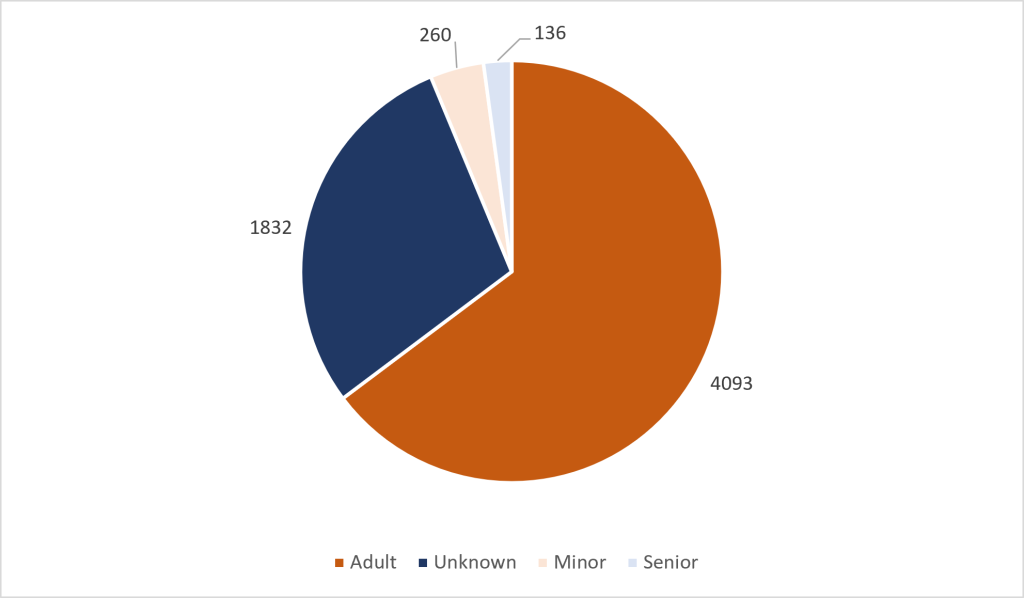
According to the data collected, there were 5,971 male and 349 female victims of arbitrary arrests and detentions. Of these, 4,093 were adults between the ages of 18 and 60. At least 260 victims were minors (220 adolescents and 40 children under the age of 14) and at least 135 victims were over the age of 60. The age of 1,832 victims remains unknown (chart 2).
In one case in early November 2000, two minors – aged 12 and 13 – and a 70-year-old resident, were detained in Alkhan-Kala in the Grozny District during a zachistka. Locals repeatedly complained against the indiscriminate detentions, mostly of young people. The two beaten minors and the elderly man were released the next day.[8]
Some instances of the detention of minors by the military were conducted in a particularly cruel manner. For example, in October 2001, the Russian military detained a 12-year-old boy from the village of Bachi-Yurt in the Kurchaloyevsky District. He was caught whilst tending to grazing cattle on the outskirts of the village. Three days later, his mutilated body was found buried in the forest. The motives for his detention are yet unknown.[9]
In another example, in October 2004, the military detained a 13-year-old boy in the Gudermessky District in order to coerce his brother – a Chechen fighter – to surrender to the authorities. However, despite the surrender of his brother, the authorities failed to release the boy and his fate is still unknown.[10]
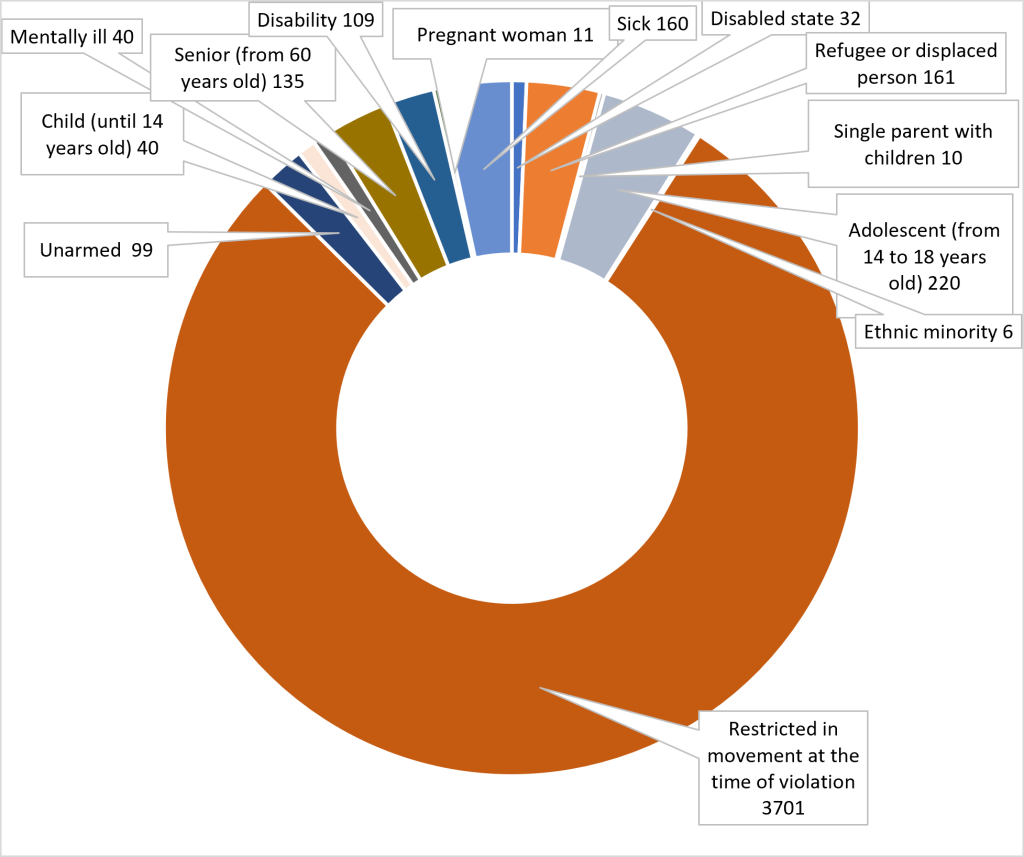
It is evident that all victims who were detained either illegally or arbitrarily had their movements restricted. In addition to this, at least 4,086 victims belonged to a vulnerable group at the time of their detention, as depicted below (chart 3).
This also held true for women with young children. For example, in January 2006, in the village of Kurchaloy, employees of the anti-terrorism center abducted a woman who worked at a local health clinic from her house. No reasons were provided for her detention. She had a young child.[11]
Another woman – a mother of two and a widow – was detained soon after the murder of her husband. She was held together with her young child at the Gudermessky District Office of the Interior (ROVD).[12]
11 pregnant women also became victims of detention. In one case, a pregnant woman was detained at Chernokozovo prison for unknown reasons and subsequently suffered a miscarriage as a result of her detention. According to the victim’s sister:
The Gudermes prosecutor led me to the Command, they began to search for my sister. We were informed from Chernokozovo that one pregnant woman was transferred to hospital. I immediately went there, but it turned out that this was another woman, not my sister. She [another woman] was kept in the freezing cold in a cage in Khankala for three days. Her hands were cracked from the cold. <…> She did not eat anything for three days. On the third day, she told people about herself, as she believed she was going to die. She had been detained together with some men as they were leaving the city. They were told that they were all fighters, and that she herself was a sniper. When the men realized that they were detaining her, they gave her warm clothes. In Khankala, she was kept together with the men for the whole three days. When they brought her to Chernokozovo, the pregnant woman ended up in the same cell as my sister.[13]
More than half of the total number of victims of kidnappings and unlawful arrests – at least 4,164 – suffered at the hands of the military or law enforcement officers. A clear picture is painted of the modus operandi of the perpetrators, mainly from the Russian authorities, where no individual was spared, including those who were sick and defenseless, those with mental disabilities, internally displaced persons, children and the elderly.
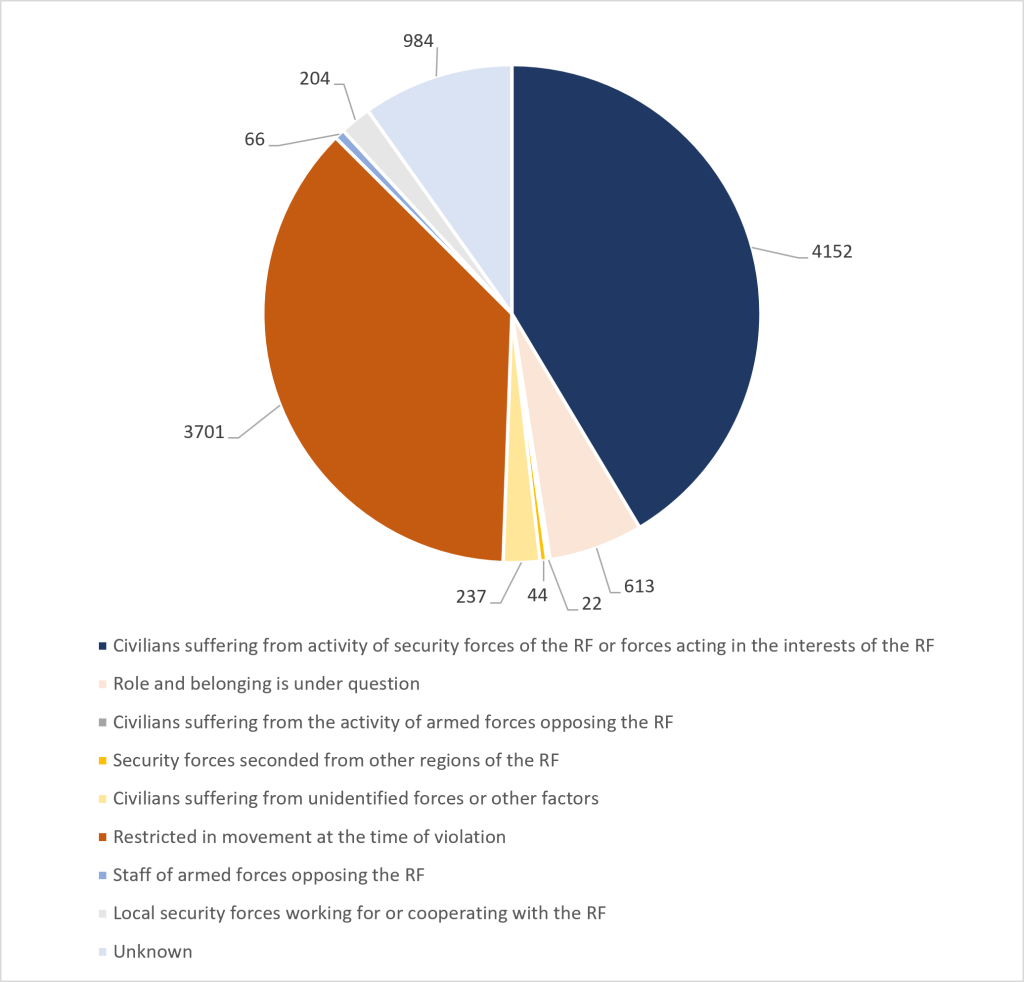
The statistics were updated on 30 April 2026.
The data is subject to change in view of the ongoing work by the Natalia Estemirova Documentation Center on the search and identification of victims of the armed conflict.
Audio library
Listen to the story of the killings of people in the Staropromyslovsky District and the removal of corpses by their relatives.
For details on this story, see the “Audio” section.
Listen to the story of a missile attack on the village of Shaami-Yurt and the detention of its inhabitants.
For details on this story, see the “Audio” section.
Listen to the story of a woman who visited her village following a “sweeping operation”.
For details on this story, see the “Audio” section.
Media library
-
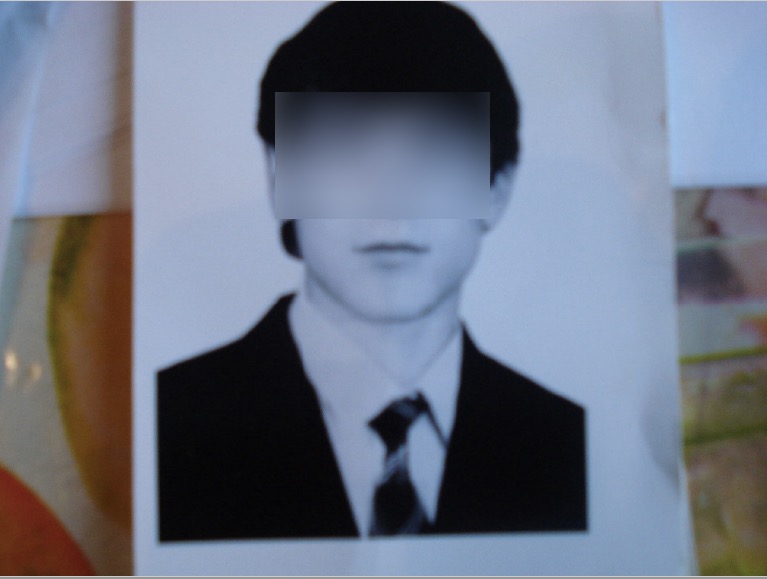
NEDC document 27479 -
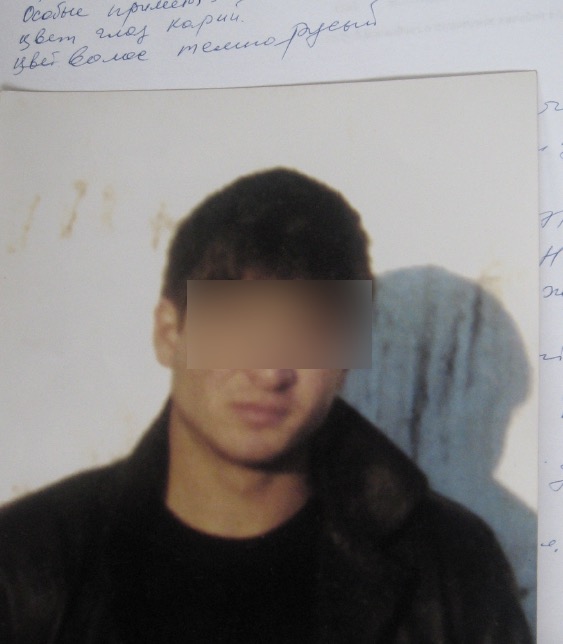
NEDC document 26869 -
NEDC document 26677 -
NEDC document 26383 -
NEDC document 27970 -
NEDC document 26848
References
[1]The statistics do not include residents of Chechnya who had been abducted in neighboring regions, as well as residents of Ingushetia, Dagestan and other republics of the North Caucasus, who have been victims of abductions and unlawful detentions in connection with the armed conflict in Chechnya. The Database mainly contains information about violations committed during the period of the second armed conflict that started in 1999. However, it also contains sporadic facts recorded during the first armed conflict.
[2]The total number in the table may differ from the total number of victims due to the fact that some victims were detained more than once.
[3]Incident № 876 «Detention in Tangi-Chu, July 29, 2000».
[4]Incident № 3178 «Kidnapping and killing in Grozny, September-October 2002».
[5]Victim № 63984.
[6]Incident № 650 «Zachistka in Argun, March 11-14, 2001».
[7]Victim № 40965.
[8]Incident № 1446 «Kidnapping of residents Alkhan-Kala, November 2000».
[9]Incident № 3745 «Detention and killing of residents of Bachi-Yurt, October, 2001».
[10]Incident № 1802 «Persecution of the family of A., Noybera village, 2004».
[11]Victim № 65128.
[12]Victim № 64165.
[13]Document № 7760 «Testimony of sister […]».